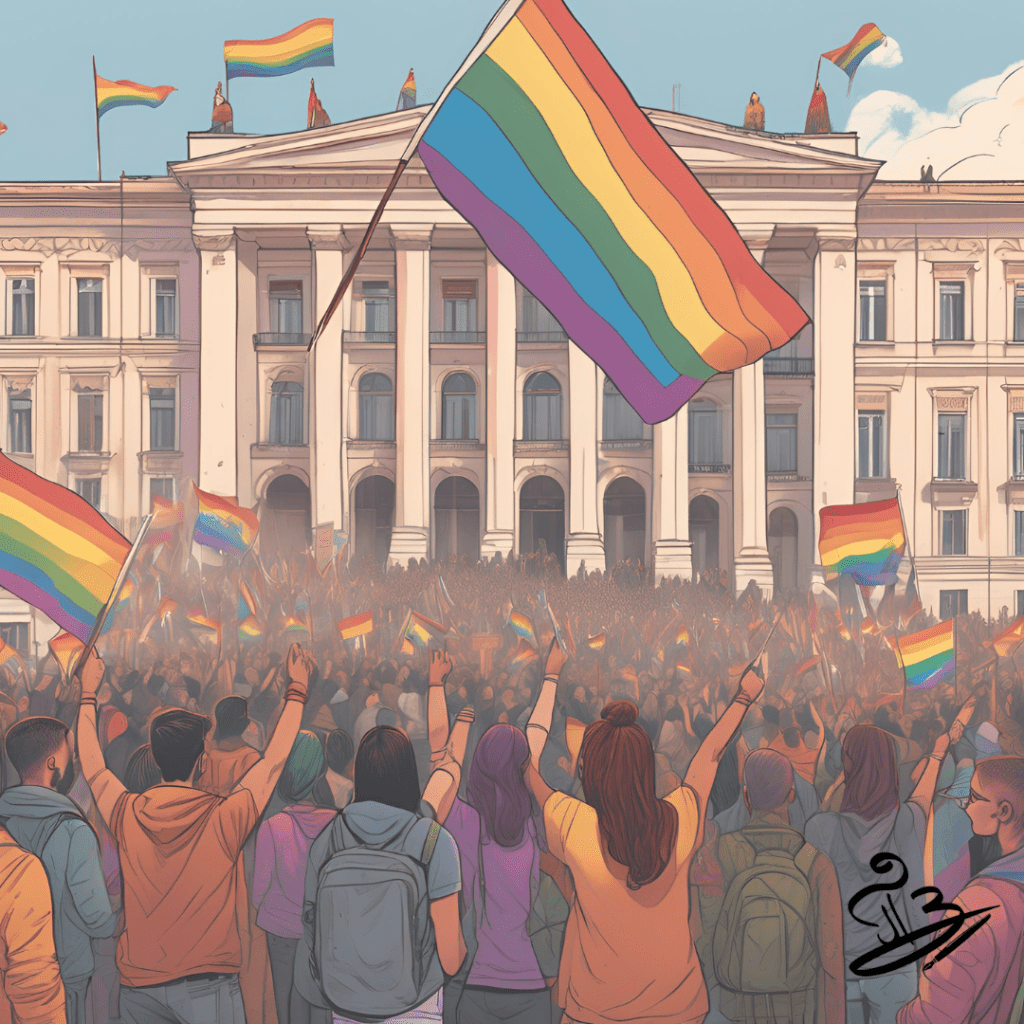
In the 21st century, we are supposed to be moving forward rather than backward. Technology and science have enabled us to do so much, and yet our thinking sometimes is lagging behind. Humankind invented artificial intelligence, particle accelerators, nuclear power, and vaccines but somehow we are struggling to progress on simple topics such as human rights. Ironic, right?
Coming from Bulgaria, I realize how much we as a community have to do to reach the quality of life of Western European countries. I guess seeing how my home country is taking huge steps backward makes me sad, especially when we just became partially part of the Schengen area and there have been multiple discussions of becoming part of the eurozone. Bulgaria is supposed to be following the West but somehow it still manages to focus on the wrong things.
I was more than disappointed when I found out about the current anti-LGBTQ+ law that the government unanimously accepted at the beginning of August.
After that, the Bulgarian President, Rumen Radev, signed this law. This was no surprise, given his background with the Bulgarian Communist Party in the 80s. Despite multiple calls from organizations, EU institutions, and NGOs to veto the law, the president signed and now the LGBTQ+ society in Bulgaria is facing a big challenge. The question now is how is this going to impact the social life of young people?
On August 16, the Bulgarian parliament published the amendment to the Law for preschool and school education. It now states that the following is not allowed: “In the preschool and school education systems, actions related to carrying out propaganda, promoting or inciting in any way, directly or indirectly, ideas and views related to non-traditional sexual orientation and/or determination of gender identity other than biological.” The text of the law opens doors to discrimination and different types of social restrictions in the education system.
It is no secret that Bulgaria is one of the 6 European countries in which same-sex marriage is illegal.
There is visible discrimination and one of the most common things I have heard people say is “I don’t care where on the LGBTQ+ spectrum you are, just don’t stick it in my face.”
Another question that this particular law amendment raises is why fuel more hate towards a community that literally does no harm to anyone and is already under so much pressure. Well, the answer when it comes to Bulgaria and Bulgarian politics is simple. The next elections are scheduled for October 27 and certain parties need to gain followers.
Rather than thinking about this, Bulgarian politicians could be focusing on innovation in schools, renovating highways, raising the minimum wage, or trying to tackle corruption.
By the way, did you know that the minimum wage in Bulgaria as of January 2024 is 933 BGN which equals 477 EUR?
Additionally, it is also important to note that there is no such thing as “LGBTQ+ propaganda in schools” in Bulgaria. Data published by zemlevezh shows that there are no schools that do such a thing. Then what do Bulgarian politicians aim to enforce with this law?
Zemlevezh posted on Instagram that in Bulgaria, people often speak about “gender ideology” which is an imaginary concept. It has often been used for political electoral gains. According to political parties such as Vazrazhdane (Revival), the education system, the media, and Western influence aim to corrupt Bulgarian children by triggering non-traditional sexual orientation and non-existent gender identity.
I knew something had gone totally wrong when headlines from Euronews and POLITICO started popping into my feed about this. Bulgaria is rarely on international news and if we make it there, it usually means something bad has happened.
This event sparked multiple protests outside the Bulgarian Parliament, which didn’t seem to be successful. Besides the protests, teachers took their own initiative to sign against the amendment to the education law, prohibiting LGBTQ+ propaganda. The response to this was that Vazrazhdane-Varna blacklisted the names of these teachers and professors.
A teacher from the Black list stated that “this is a law similar to other laws in totalitarian regimes, to forbid someone to speak.” While politicians are busy with these things, they rarely attribute the needed attention to the fact that Bulgaria’s schoolteachers are among the oldest in the EU and shortages are emerging. According to data published by the European Comission about 50% of school teachers in Bulgaria are at least 50 years old and 31.3% are at least 55.
Just to give a reference. My mother is a teacher in a small village school near our hometown. The team is 13 teachers. There are less than 100 children but enough for the school to be still operating. 10 out of the 13 teachers working there are over 50 years old, including my mother.
This means that in the next decade, Bulgaria will likely see close to one third of school teachers retire. And I am not particularly sure how education will be an attractive career path for young people if what they see is a space fostering stigma and segregation. Additionally, many people flee from Bulgaria in search of a better life for one reason or another. I am one of them. In 2016 I left my home to look for a better quality of education and ideally life.
Enough young people are leaving Bulgaria daily. Spending 8 years abroad showed me how Bulgarians are everywhere. I am guilty as well. But is this law going to set a new precedent for more to flee?
 3xpwriting
Leave a comment