In about a month, Bulgaria is set to adopt the euro and formally leave its lev behind. Despite the positive impact this move is expected to have, many Bulgarian citizens still describe the situation as something that “would make the poor poorer” or as an action that “won’t bring any added value to the country.” As Bulgaria continues to navigate the challenges, people are increasingly polarised by fake news, propaganda, and misinformation.
Earlier in November 2025, POLITICO reported that there are fears about inflation and centralisation of powers. These fears are exaggerated by disinformation campaigns and pushing many to protest – concerns expected to rise in a country with a highly unstable political system.
Bulgarians often refer to Greece, worrying that Bulgaria will follow its path, leading many to face financial hardship. Greece adopted the euro in 2002, which before bringing prosperity first led to significant struggles. During the 1980s and 1990s, the country built up debt of approximately 103% of its GDP, above the EU’s limit of 60%. Despite this, Greece still joined the eurozone but later it was revealed that the government had manipulated its financial figures to qualify, according to the Berkeley Economic Review. However, many in Bulgaria lack precise information about Greece’s political situation in the early 2000s, which makes them more sceptical about the change.
Now, many in Bulgaria worry that the same will happen. In fact, grocery prices in supermarkets have already skyrocketed while the minimum wage will be €620.20 per month as of 2026, a 12.6% increase from the current minimum wage, reports BNA. However, this is unlikely to cover already high prices. Yet with or without the euro, the average Bulgarian has to make ends meet with what they have.
Currently, the minimum wage in Bulgaria is BGN 1,077, approximately €551 per month. In 2023, the average adjusted monthly salary for full-time employees ranged from €1,125 in Bulgaria to €6,755 in Luxembourg. The EU average was €3,155. However, many people in Bulgaria live on less than the average.
My interest in what people thought about the euro led me conduct a small case study. POLITICO reported that half of the people in Bulgaria held largely negative views about the eurozone. Therefore, I decided to ask around and gathered insights from 52 people in my network, exploring how they perceived this move.
In total, 28 male and 24 female respondents aged 20-70 shared their thoughts. Most participants are people living and working in Bulgaria, primarily aged in their late 20s or around their 50s.
The results from this case study were slightly surprising, with the most interesting finding concerning people who wouldn’t want to use the euro in Bulgaria. According to the small sample of 52 participants, those who viewed the euro negatively were either currently living and working in other European countries, or had done so in the past.
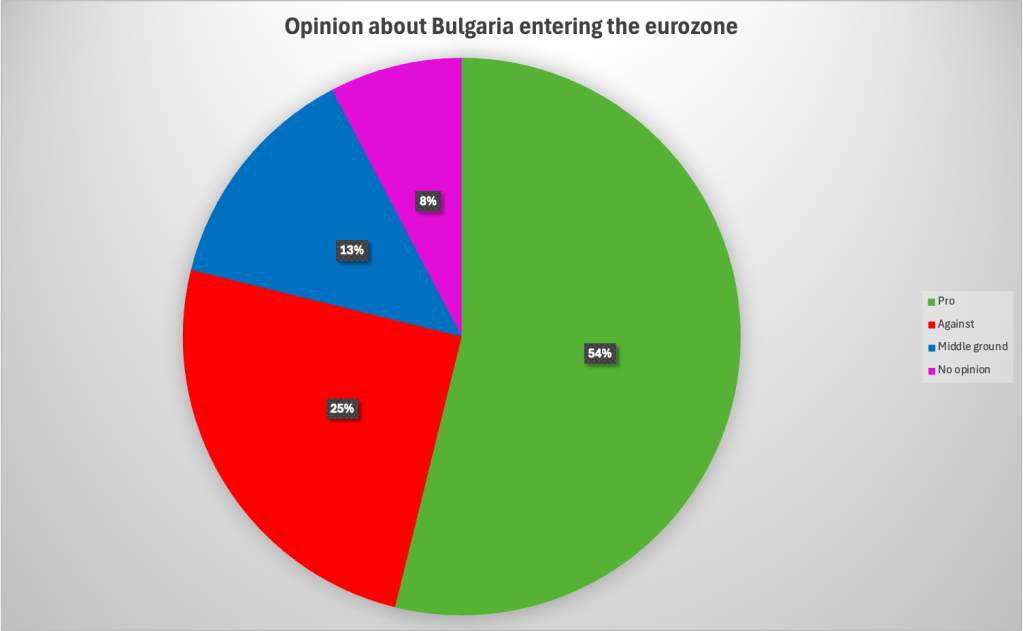
The results indicate that 54% expressed a positive opinion of this step, highlighting that greater oversights from Brussels could benefit Bulgaria, given its corruption problems. A further 25% of shared a negative perspective. The remaining 21% said they “didn’t care much about it” or acknowledged both the fadvantages and disadvantages aspects of adopting the euro.
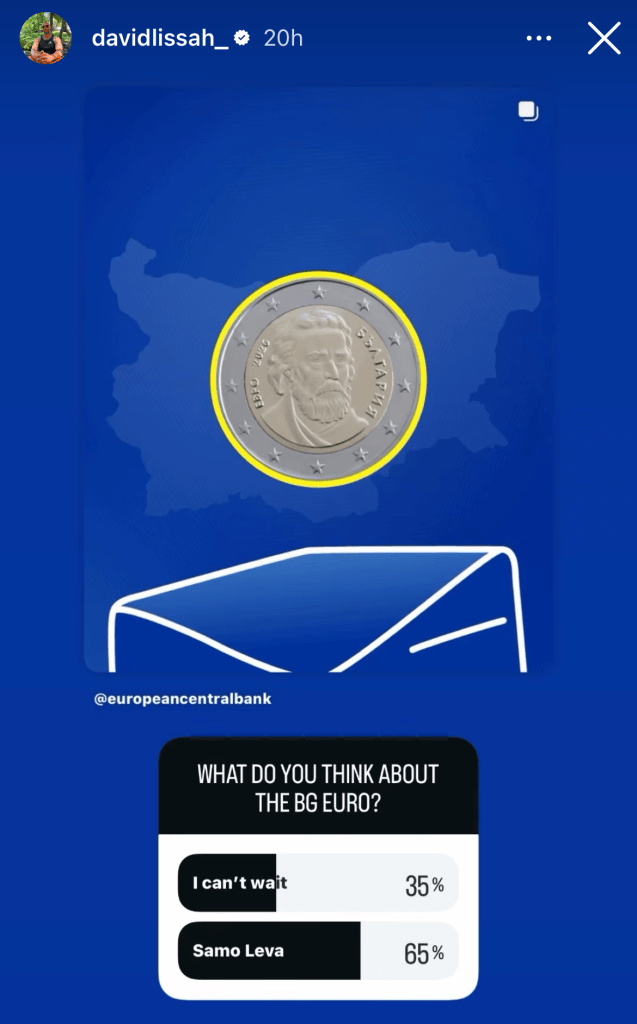
Similarly, social media influencer davidlissah_ who currently lives in Bulgaria, posted a poll, which received 65% negative responses. A surprise given his marketing background, international audience and him not really voicing political views on Instagram.
In an interview with BTV, he shared his views about Bulgarian prices and salaries. In fact, Lissah compared the average salary to the prices of the products, explaining that this is where “the problem comes from.” In his interview, he highlighted that the disparity between salaries and prices is mostly felt outside of Bulgaria’s capital, Sofia, where people generally earn less.
How do then the rising prices in Bulgaria connect to the euro? One respondent to my study revealed that the salesperson in the local grocery store told them that “adopting the euro would increase all prices, so I raise my prices in advance to avoid getting screwed.”
My study raised another question: Why people living abroad would not want the euro? Didn’t they leave Bulgaria in search for better life in Western Europe, where the euro has been the currency for a while?
Participants with positive views also acknowledged the benefits of joining the eurozone. Jane Doe explained that she wants to adopt the currency because “finally we will be equal to other European countries.”
Another benefit for Bulgaria joining the eurozone would be lower borrowing costs, making debt cheaper to service. This is expected to help the country become more financially self-sustaining, writes Simeon Yanev.
Additionally, in the beginning of November 2025 Christine Lagarde, President of the European Central Bank (ECB), visited Bulgaria and personally welcomed the country to the eurozone. She highlighted that one of the best reactions to the adoption of the euro is not speculation but seeing what happens in real life once the particular country enters the eurozone, writes News.bg.
“Adopting the euro brings two key benefits for Bulgaria: prosperity and security,” said Lagarde in her speech. “Under its currency board, Bulgaria has already enjoyed much of the exchange rate stability that euro area membership provides. But adopting the euro will take this integration one step further by removing the last currency barriers within the Single Market.” What Lagarde refers to is the fixed exchange rate between the lev and the euro since 1997.
Lagarde also acknowledged some other fears relating to loss of sovereignity and the fact that the new currency will be subordinate to European decision. “Given the lev’s long history as a symbol of Bulgaria’s independence, this feeling is entirely understandable. But joining the euro is not a loss of sovereignty – it is a gain,” she said.
And where do I stand? It doesn’t really matter. The decision has already been made. I have not lived in Bulgaria for a very long time, so using the euro will not be new to me.
The names of people have been purposefully changed or omitted.
 3xpwriting
Leave a comment